Revisiting Galaxy Evolution in Morphology in the Cosmic Evolution Survey Field (COSMOS-ReGEM). I. Merging Galaxies
Galactic interactions and mergers are one of the most fundamental and important processes in cosmic evolution. Merging galaxies can be identified by the human eye or some non-parametric morphological parameter methods as well as machine learning in high-resolution deep images. Another method to study galaxy mergers is to find pairs of galaxies that are close together and have relatively low velocities. However, this method requires a sample with a sufficient number of spectral redshifts or highly accurate photometric redshifts to reduce projection effects. Currently, there are still significant differences in the study of the redshift evolution of merger rates and the impact of mergers on galaxy properties using different identification methods for merging galaxy samples or the same method on different observational data.
To address the above scientific issues, we constructing 33605 0.2<z<1 mass complete galaxy sample in the COSMOS field with the highest spectral redshifts fraction (41%) and the highest photometric redshift accuracy (nearly twice as accurate as the photometric redshifts in the latest COSMOS2020/CLASSIC catalog). From this sample, we obtained two merging galaxy sample based on irregular morphology and galaxy pairs. We use these two types of merging galaxy samples to precisely determine the evolution of the merger fraction and merger rate.
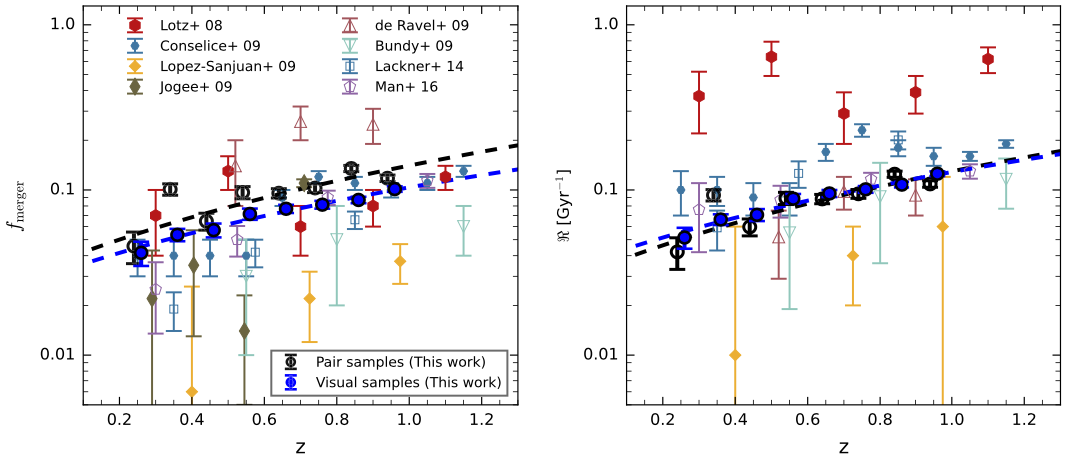
Figure 1. The evolution of the merger fraction (left) and merger rate (right) identified by different methods .
In addition, by comparing the different morphological parameters of merging and non-merging galaxies, we find that the second-order moment parameter (M20) and the outer asymmetry parameter (Ao) of galaxies are highly sensitive to the morphology of merging galaxies, and proposed a new method Ao-M20 for selecting merging galaxy candidates. The precise redshift sample and new merging galaxy candidate identification method reconstructed in this work will soon be used in the JWST-SPTING project to precisely characterize the evolution of galaxy merger rates from the early universe to the nearby universe.
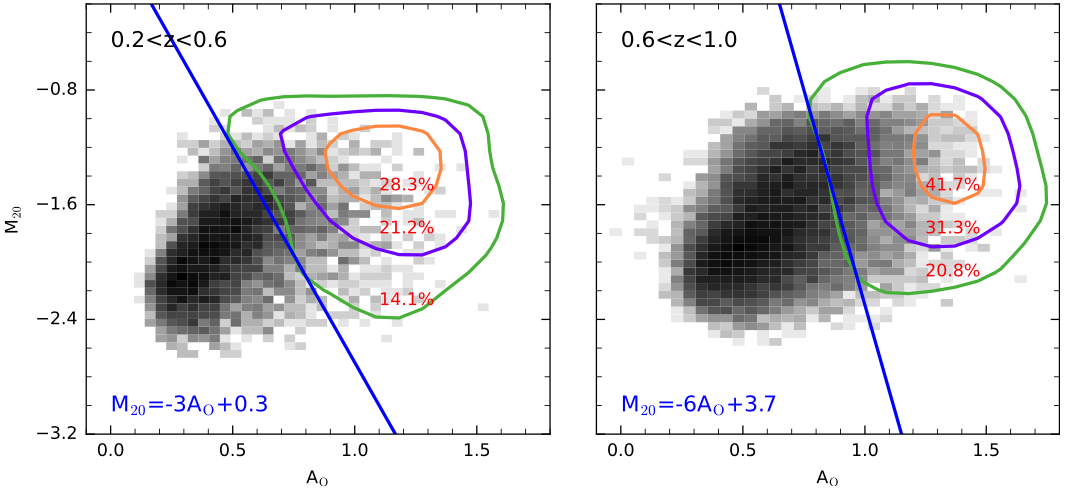
Figure 2. The Distribution of merger fraction in the AO − M20 diagram. The black density map is the number density of the subsample. In each panel, the contours from outer to inner represent the merger fraction, which is 2, 3, and 4 times the average value in each subsample masked by red numbers. The solid blue line is the merger candidate selection criterion in each subsample.