Color gradients and possible origin of Ultra diffuse galaxies
Ultra diffuse galaxies (UDGs) are a kind of galaxy with extremely low surface brightness (>24 mag/arcsec) and extended size (Re>1.5 kpc). UDGs have low stellar mass and old stellar population. They are more frequently found to be located in galaxy cluster, which addresses a great puzzle how these kind of galaxies form and survive in the dense cluster environment given their diffuseness. One thought is UDGs found in clusters must have relatively large amount of dark matter so that they will not be distroyed by the tidal foces from cluster. Some works study UDGs in different environment, they find UDGs in field environment are usually bluer than cluster UDGs, which suggests UDGs may form in field and fall into galaxy group or cluster later, the gas content of UDGs is then stripped during the falling process and finally the star formation activities cease.


Since the nature of faintness, previous studies on UDGs are limited in local universe. The Hubble Frontier Field (HFF) program takes deep imaging data on six massive galaxy cluster at redshift 0.3<z<0.6, providing great chance for searching and studying UDGs beyong local universe. Color gradients of galaxies reflect the stellar population distribution and resemble history of galaxy, which has not been suffieciently investigated for UDGs. We take use of deep imaging data from HFF and photometric and redshift catalog of Shipley+18 to find UDGs in cluster field of 6 galaxy clusters. After pre-selection, background re-subtraction, GALFIT fitting, we finally identify 108 UDGs in total. A snapshot of several selected UDGs are shown below.
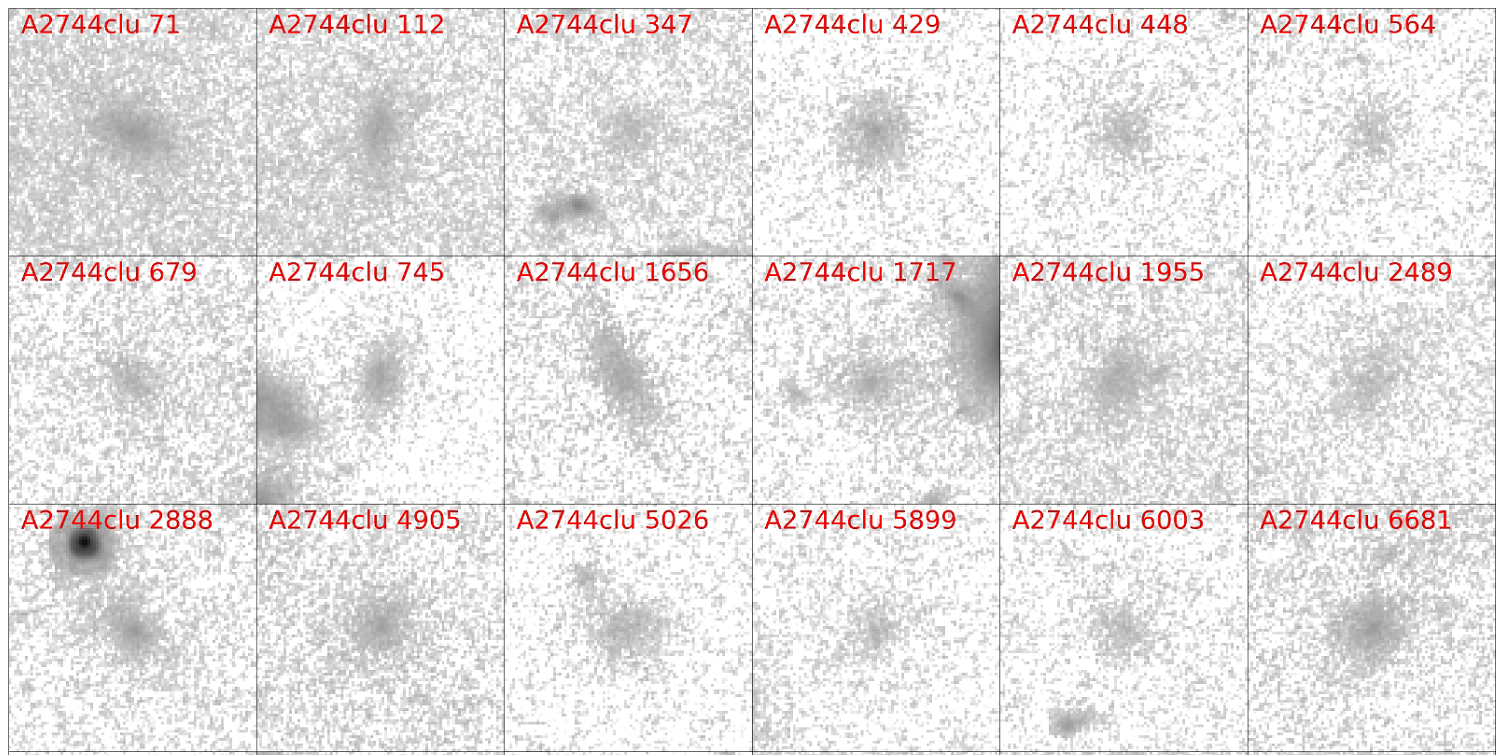
Figure: cutout images of 18 selected UDGs in our sample, image size 12x12 kpc at the redshift of corresponding cluster.
We measure the color gradients of our UDGs and compare to UDGs found in local Coma cluster, reuslts are shown below. Unlike UDGs found in local clusters, which are mostly thought to be old and quenched, a majority of HFF UDGs show a blue color in rest-frame U-V, indicating they still have star-forming activities. Though Coma UDGs show quite different color from HFF UDGs, both show little radial color gradient. This provide a hint that star forming activities in UDGs may fade and quench universally.
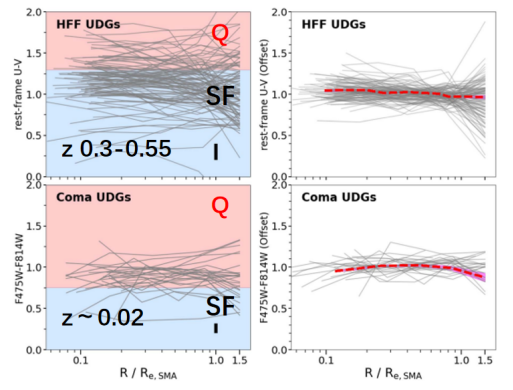
Figure: Comparison of radial color gradients between HFF UDGs and Coma UDGs.
In left two panels, the color is coded accroding to a typical boundary for star forming and quenched galaxies. In right two panels, all color curves are offset and a median magenta curve with no significant gradients are presents.
Another interesting finding is that, after correcting all possible systematic effect, like cosmic dimming effect, competeness effect, etc., the normalized surface number density of UDGs among these 6 galaxy clusters show an obvious gap at around z~0.4. Specifically, the surface number density of UDGs in two z~0.55 clusters are significantly lower than those of other four clusters which have z<0.4. This seems to be consistant with the simulation work (Rong+17) , indicates UDGs could be falling into dense environment across the cosmic time. This result also imply the well established relationship between UDG abundance and total mass of galaxy cluster, which is based on local universe, may vary with the cosmic time.
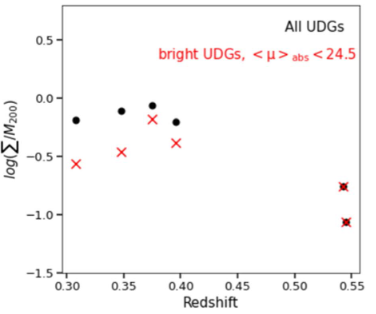
Figure: Surface number density of UDGs among 6 HFF clusters.