Comparing processed MIRI imaging quality: JWST-SPRING versus CEERS
The JWST MIRI image processing workflow consists of three stages,
Stage 1:
In Stage 1 of the JWST Calibration Pipeline, a series of essential data processing steps are performed to prepare and refine the raw data. These steps include data quality initialization, saturation checking, correction for reset anomalies, first-frame and last-frame corrections, linearity correction, RSCD correction, dark current subtraction, reference pixel correction, jump detection, and slope fitting—each step optimized for MIRI-specific characteristics. Utilizing the pipeline's default parameters ensures consistency and reliability in the calibration of observational data.
Stage 2:
During Stage 2 processing, we observed significant "stripe-like" noise patterns in both vertical and horizontal orientations within MIRI images. The official method for removing 1/f noise was found to be ineffective for these artifacts. As a result, we replaced the standard STScI flat-field corrections with custom super-sky flats and introduced several adjustments aimed at specific issues such as stripe removal and background subtraction.
To create these super-sky flats, we selected continuous observation data from programs 1345, 1727, and 1837, dividing this data into distinct sub-datasets. For each sub-dataset, we applied Stage 1 processing using CRDS default flat files, followed by Stage 2 processing where we implemented our custom stripe removal techniques on the calibrated files. After this, we performed source detection and identified bad pixels for each image, constructing segmentation maps used to mask the rate images. Each masked count-rate image was normalized by dividing it by its sigma-clipped median value to simulate the detector's response to a uniform light source. Finally, we calculated the median across all rate files for each sub-dataset, yielding an improved representation of the detector's behavior.
Stage 3:
In Stage 3, we focused on enhancing the precision of astrometric calibration. We generated specialized reference catalogs from F444W images and used these catalogs to align MIRI images with NIRCam F444W images. This alignment process significantly improved the accuracy of source positions in MIRI images relative to those in NIRCam images across various bands.
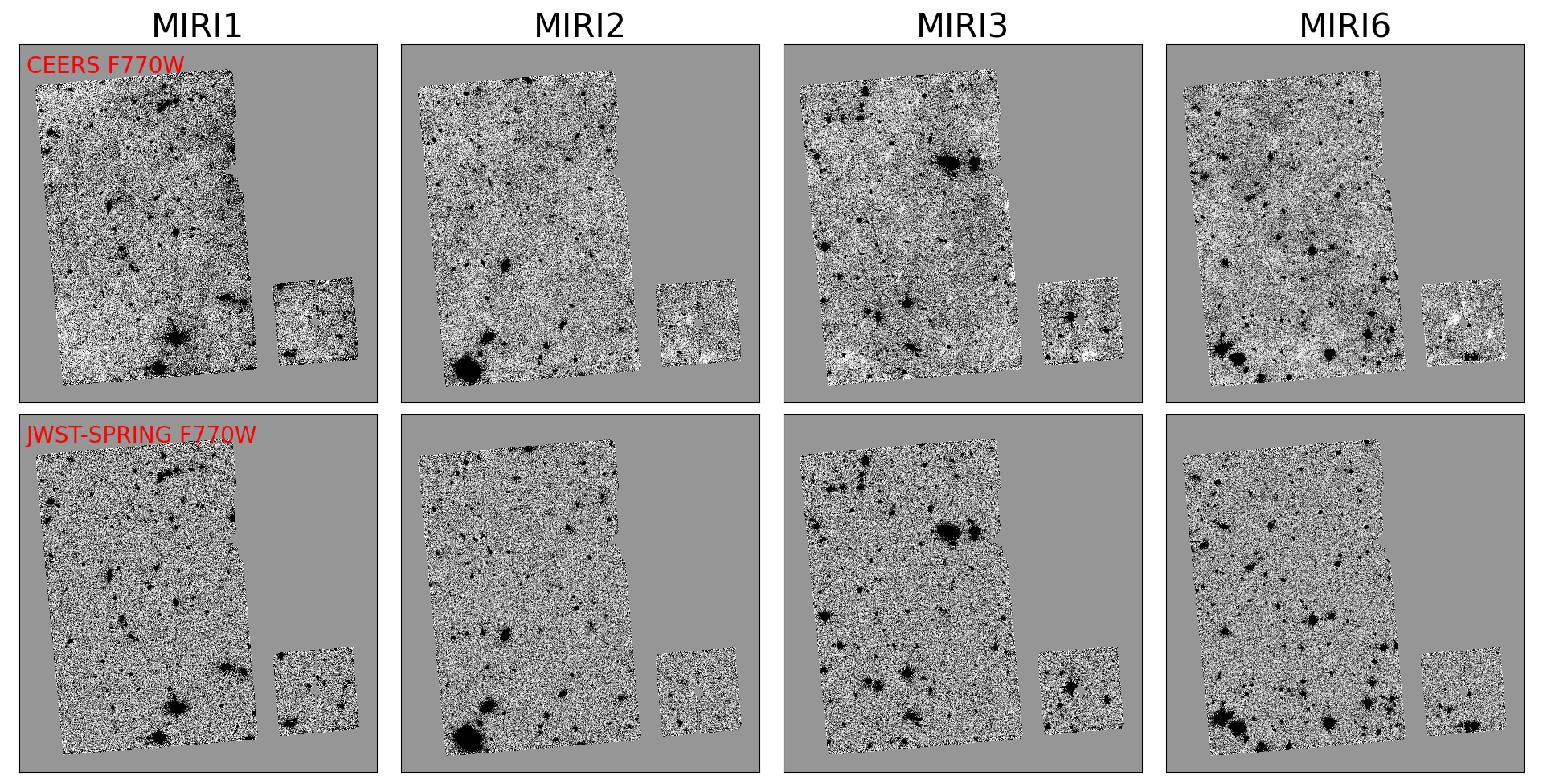
As illustrated in this figure, our processed MIRI imaging demonstrates a significant enhancement in image quality compared to data from other projects (e.g., CEERS).