Strong Lensing by Galaxies and Clusters
Gravitational lensing is a light-deflecting phenomenon when light rays pass through gravitational potential. It is so-called strong gravitational lensing when the lensing effects are strong enough to produce multiple images, arcs, or Einstein rings, primarily around high-density regions like centres of galaxies and galaxy clusters. Strong lensing by galaxies and galaxy clusters is a valuable tool for various applications in astrophysics and cosmology, e.g., investigating the nature of dark matter by measuring the mass distribution of lenses, constraining cosmological parameters via estimating the distances of lenses and sources, and as cosmic telescopes to magnify distant sources, etc.
Galaxy-scale strong lenses are mainly used to study mass structure and evolution fo galaxies, constrain the stellar initial mass function, and estimate cosmological parameters. Specifically, extended background sources can be lensed into multiple arcs or a complete Einstein ring; such systems are called galaxy-galaxy strong lenses and are applied to measure the total density profiles of the lenses as well as substructures. When the background sources are point-like, such as active galactic nuclei (AGNs), quasars, or supernovae, the lensing systems present multiple images, referred to as 'quads' or doubles when the observables are 4 or 2 detected point images, respectively. Considering the time domain information, strong lenses with multiple lensed point images are unique for constraining cosmological parameters.

The first observational detection of strong lensing by a galaxy cluster --- a giant arc in Abell 370 --- was reported in the 1980s, and so far, about 100 cluster-strong lenses have been observed. The statistical properties of lensed giant arcs and secondary arcs in cluster lenses are powerful to constrain the properties of large and small-scale structures of dark matter in the Universe. Considering the large cross-section of cluster scale strong lenses, cluster lenses often contain multiple arcs at different redshifts, which constrain cosmology models efficiently. Besides, as cluster scale lenses magnify the back sources significantly, cluster lenses are considered as Nature's Telescope, which reveals the earliest forming galaxies that would otherwise be unreachable with telescopes.
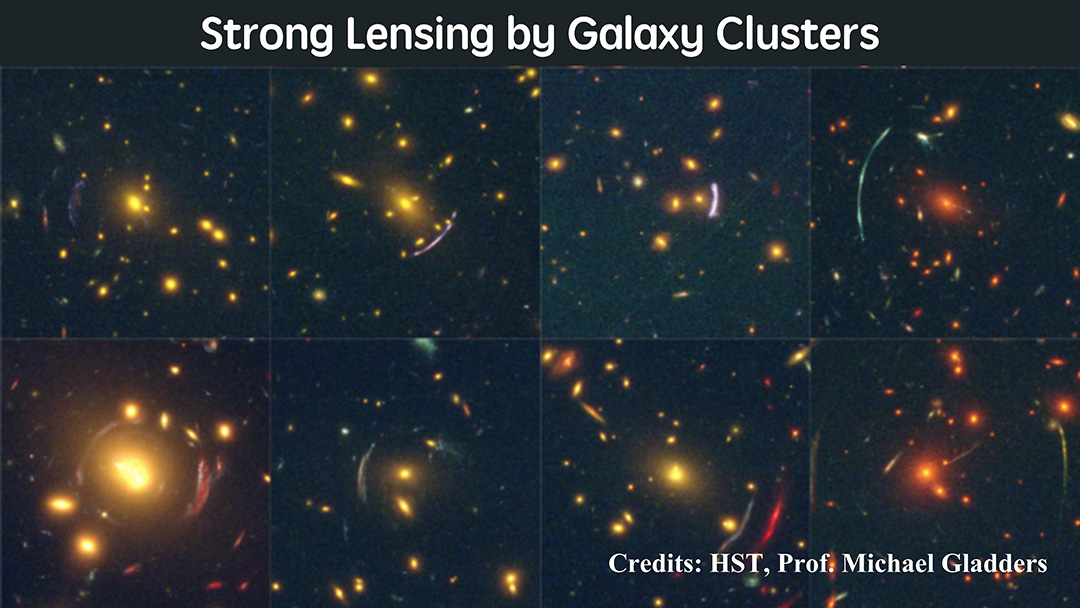
With ongoing (DESI, JWST, Euclid, LSST) and upcoming (CSST and Roman) projects, thousands of strong lenses will be detected novetly. The treasure troves of data will bring unprecedented opportunities for studying astrophysics and cosmology with strong gravitational lenses. However, bring unignorable challenges in lens-finding, target-selecting, and lens-modeling. Therefore, with strong lensing systems, one can expect a prosperous future that accurately constrains the properties of dark matter and dark energy. However, one should also be equipped with suitable techniques/algorithms like AI to prepare for such a thriving era.
References:
https://ui.adsabs.harvard.edu/abs/2024SSRv..220...19N/abstract
https://ui.adsabs.harvard.edu/abs/2022arXiv221010790S/abstract
https://ui.adsabs.harvard.edu/abs/2023arXiv230611781V/abstract
https://ui.adsabs.harvard.edu/abs/2024SSRv..220...48B/abstract