Co-evolution of AGNs and their Host galaxies
Supermassive black holes (SMBHs) at the centers of most galaxies are intricately linked to galaxy evolution over cosmic time. Active Galactic Nuclei (AGN), driven by the accretion of gas onto these black holes, can profoundly impact their host galaxies. AGN regulate gas availability and star formation rates, playing a crucial role in shaping galaxy properties and their environments. Understanding AGN feedback is essential for uncovering the broader narrative of galaxy evolution, as these feedback processes are key components in modern cosmological simulations. Without incorporating AGN feedback, simulations fail to accurately reproduce galaxy mass, star formation rates, and structure. AGN feedback can either suppress star formation through powerful winds or jets (negative feedback) or trigger new star formation by compressing surrounding gas (positive feedback). The JWST-SPRING program aim to study AGN hosts in the following aspects:
Dusty AGNs: Using Dust as a Probe of the ISM
The James Webb Space Telescope provides a unique opportunity to study AGN and their host galaxies, particularly in dust-obscured regions. JWST's advanced infrared capabilities can penetrate thick dust and gas, revealing both the central black hole and its host galaxy. This is crucial for studying the interstellar medium (ISM) of large samples of AGNs. With JWST’s comprehensive photometric coverage (0.4 to 25 μm) and archival data from HST and Herschel, we can conduct detailed spectral energy distribution (SED) analyses. This will allow us to characterize star formation rates, dust content, and stellar population properties in AGN hosts, enhancing our understanding of how ISM influences AGN activity and is impacted by AGN feedback.
Unobscured AGNs: Disentangling AGN and Host Emission
JWST’s high spatial resolution will help disintangle AGN emission from host galaxy light in unobscured (Type 1) AGNs. This capability allows us to accurately measure host galaxy properties and explore their evolutionary stages. Current knowledge of distant unobscured AGN hosts, particularly regarding central or bulge properties, is limited. JWST will reveal the relationship between SMBH characteristics and their host galaxies’ central regions, providing precise measurements of central mass density, star formation rates, and dust content. This will deepen our understanding of the co-evolution between SMBHs and the bulge growth of their host galaxies
Studying the Morphology and Structure of AGN Hosts
Comparing the morphology and structure of AGN host galaxies with non-AGN galaxies is key to understanding AGN fueling and feedback processes. Structural features such as strutural perturbations due galaxy mergers, bars, and spiral arms influence gas inflows towards the central black hole. Mergers can funnel gas into the nucleus, while bars and spiral arms facilitate steady inflows. By utilizing our team’s expertise in image analysis and both parametric and non-parametric structural measurements, we can compare AGN hosts with non-active galaxies to gain insights into how AGN activity influences galaxy evolution. Although the link between galaxy structure and AGN activity remains unclear, this comprehensive study aims to bridge that gap.
Comparing Observed and Simulated AGNs
Given the diversity of AGN host galaxies and the nuanced effects of AGN feedback, comparing observed and simulated AGNs is vital for advancing our understanding of AGN physics and galaxy evolution. Key aspects such as AGN fraction or abundance, host galaxy characteristics, and large-scale environments provide crucial insights. This comparison will enhance our understanding of how AGN feedback shapes galaxies over time and their evolution from the early universe to the present. JWST’s capabilities will further this research by revealing early and low-luminosity supermassive black holes and their co-evolution with galaxy properties, bridging observations across different cosmic epochs. This comparison with simulations will deepen our understanding of the interplay between AGN activity, host galaxy properties, and cosmic evolution.
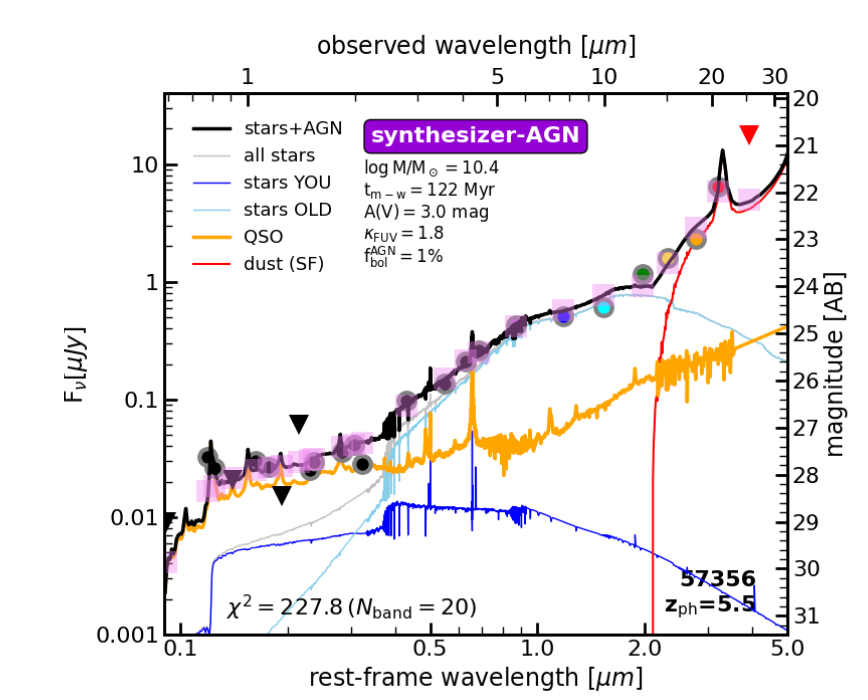
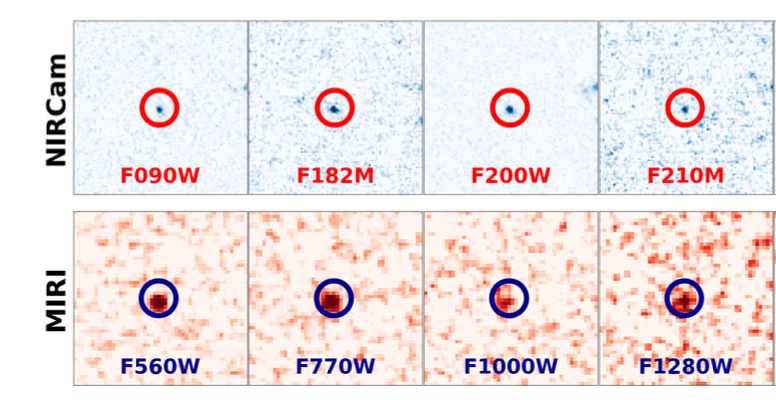
Figure: SED fitting results for JWST galaxy JADES-57356, which is one of the new class of AGNs termed as little red dots. Left panels shows the SED modelling including young, old, and all stars in blue, cyan, and gray, (un)obscured AGN in orange, and dust emission in red; On the right 10′′×10′′ postage stamps show example in NIRCam and MIRI images of this AGN. Source: Perez-Gonzalez et al. 2024