The Cosmic Web and the Role of Environments
Galaxies rarely exist in isolation; the environment in which a galaxy resides plays a crucial role in its formation and evolution. The multiscale environment facilitates galaxy mergers and interactions, influences gas content, star formation rates, AGN activity, and structural transformations. Dense environments can suppress star formation through quenching mechanisms like ram-pressure stripping and strangulation (gas accretion cut off), while galaxies in isolated regions may experience enhanced gas accretion or retain their gas longer, sustaining star formation over extended periods.
The JWST-SPRING program aims to conduct reliable and comprehensive analyses of the environments of distant galaxies and their associations with other galaxy properties, using multiwavelength data including JWST and HST in fields like COSMOS. Understanding the role of the environment in the evolution of distant galaxies has been challenging, partly due to the lack of spectroscopic redshifts necessary to accurately quantify these environments.
In contrast, spectroscopic surveys like SDSS and GAMA have enabled extensive studies of the multiscale environments of nearby galaxies. Research suggests that a combination of recent gas accretion (both diffuse or merger-related) in low-density environments, leading to episodic starbursts and black hole activity, along with ancient bulge buildup, offers a plausible explanation for the observed properties of nearby galaxies (Yesuf et al. 2021; Yesuf 2022 and references therein). To unravel the evolution history of quiescent galaxies in high-density environments today, it is essential to study the environments and assembly histories of distant galaxies.
Some studies have reported a controversial reversal of environmental density relations in distant galaxies compared to nearby ones. Unlike the local universe, where dense environments is mostly occupied by quiescent galaxies, observations of distant galaxies (z > 1) suggest higher star formation rates in these regions. This reversal might be due to different evolutionary stages, environmental pre-processing, and varying feedback mechanisms over cosmic time. With the availability of spectroscopic redshifts for a significant fraction of distant galaxies and high-quality photometric redshifts, we can now begin to reliably characterize multiscale environments and explore their influence on distant galaxy properties. The JWST-SPRING program is poised to enhance our understanding of these complex processes, providing new insights into galaxy evolution across different environments.

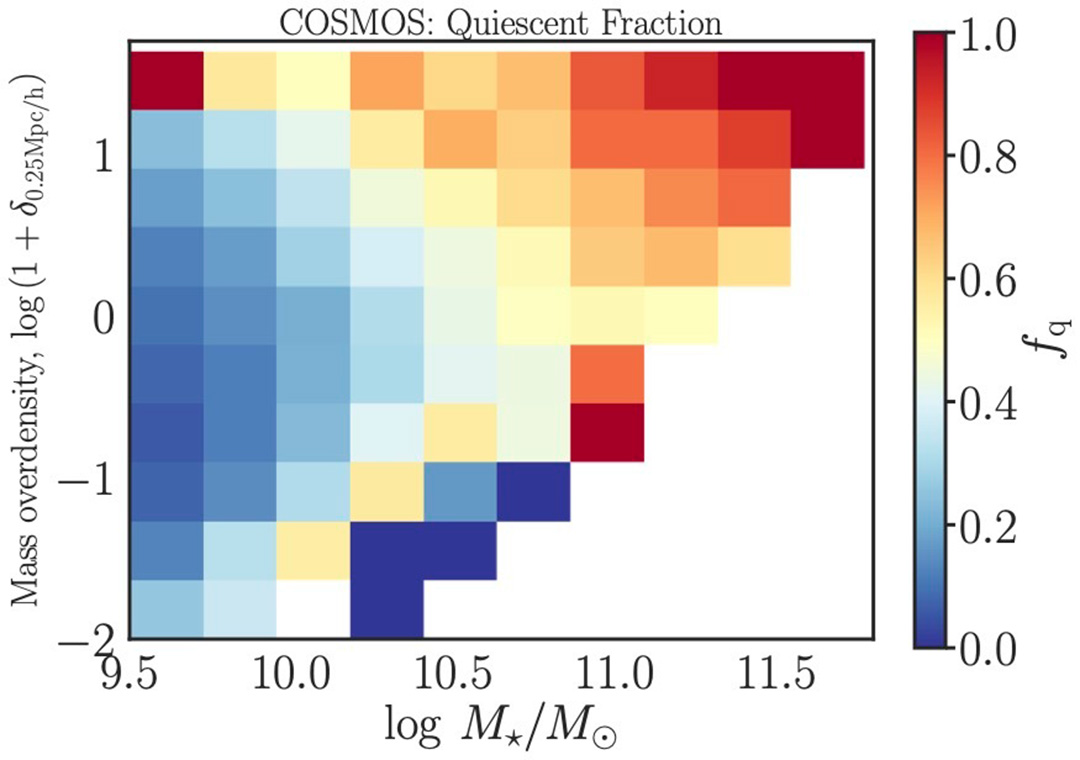
Figure: Top panel shows distribution of galaxies at z=0.7 in COSMOS color-coded by their enviromental overdensities. Bottom panel shows the quenched fraction of galaxies in COSMOS at z=0.6-1.0 depends not only on their stellar masses but also their enviroments (Yesuf et al. in prep.).