The Color and Stellar Population Gradients
Color gradients reflects the spatial distribution of the stellar population(age, sSFR, dust attenuation, metallicity ,etc) within a galaxy. The spatial distribution of the stellar population can provide essential clues to understand how galaxies are builtup and shutdown. Color gradients also reflects the mass-to-light ratio gradients of a galaxy, thus influence the estimation of the morphology of a galaxy(Suess et al. 2019). Additionally, Color gradients bias the shear measurements in the weak lensing study(Er et al. 2018). The study of color gradients is pivotal in the field of galaxy evolution.
In tle local universe, early-type galaxies(ETGs) usually show negative optical and near-infrared color gradients dominated by metallticty gradients(Wu et al.2005). Late-type galaxies(LTGs) also show negative color gradients, but has more complex origination(age, dust, metallicity gradients all contribute to the color gradients)(Tortora et al.2010, Gonzalez-Perez et al 2011). At higher redshift, the study of color gradients needs high spatial-resolution image data in deep fields. In the early stage, observe-frame optical images obtained by HST/ACS can only provide rest-frame UV color gradients of the galaxies at cosmic noon, limiting the inference of the underlying distribution of stellar population(Moth et al. 2002). At CANDELS epoch, near-infrared camera WFC3 images were obtained, leading to the discovery of rest-frame optical natural of the galaxies at cosmic noon. Several studies have reported negative color gradients for star-forming galaxies, green-valley galaxies, quiescent galaxies(Guo et al 2011, Suess et al. 2020). To translate the color gradients to stellar population gradients, stellar age/specific star formation rate(sSFR)-dust-metallicity degenaracy should be broken. Several empirical calibration methods(e.g. UVI diagram(Wang et al.2017), UV color dust correction(Liu et al. 2017), SED modelling dust correction(Liu et al. 2016), etc. ) have been developed to recover the underlying stellar population gradients and infer the star-formation and quenching mode of high-redshift galaxies. These studies reveal that the star-formation mode depends on both stellar mass and redshift. At cosmic noon(z~2), the negative color gradients of star-forming galaxies with stellar mass below 10^11M_{\odot} is dominated by the dust gradients and the sSFR gradients is negligible(Liu et al.2017). But for the most-massive star-forming galaxies with stellar mass above 10^11M_{\astr}/M_{\odot}, based on both IFU and HST images, Tachella et al reported that the star-formation activity is suppressed at the center relative to the outskirts, suggesting an inside-out quenching scenario for the most massive galaxies. At lower redshift(z~1), the case is similar, but the stellar mass transition point become lower to 10^10 to 10^10.5M_{\astr}/M_{\odot}(Liu et al.2016, Wang et al.2017), supporting a downsizing evolution scenario of galaxies. For green-valley galaxies, at redshift below 1, massive galaxies show inside-out quenching mode via internal process, in contrast, low-mass galaxies show outside-in quenching mode related to external process(Pan et al.2015, Liu et al.2018).
JWST has unprecedented wavelength coverage towards the near-infrared(NIRCam) and mid-infrared(MIRI) , depth and spatial resolution. Benefiting from these characteristics, the oriigin of color gradients can be depicted more explicitly. Several studies have verified that the color gradients of star-forming galaxies at cosmic noon are driven mainly from the dust gradients(Miller et al. 2022), consistent with previous studies based on HST/CANDELS survey. The JWST-SPRING program aims to conduct reliable color gradients and stellar population gradients measurements of distant galaxies and their correlations with galaxy properties(redshift, star-forming properties, stellar mass, etc) based on a mass-complete sample. The results will give a comprehensive picture of how the stellar mass is bulitup and shutdown across the cosmic history. Compared to the results provided by HST, the JWST-SPRING program can give more reliable results less affected by the degeneracy of stellar population parameters, and extend the picture of stellar mass assembly history to higher redshift and lower mass.
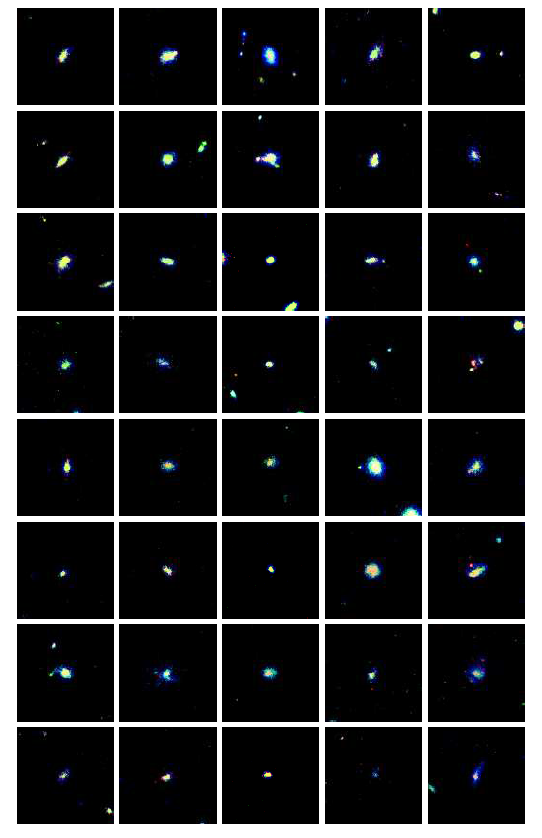
Figure. Three-color coadded postage stamps(composed of F115W, F200W, F356W) for green-valley dwarf galaxies at 1<z<1.5 obtained by JWST. These galaxies show flat or negative color gradients, indicating a self-similar or inside-out quenching mode(Li et al. in prep.).
References:
https://ui.adsabs.harvard.edu/abs/2002AJ....124.1886M/abstract
https://ui.adsabs.harvard.edu/abs/2005ApJ...622..244W/abstract
https://ui.adsabs.harvard.edu/#abs/2010MNRAS.407..144T/abstract
https://ui.adsabs.harvard.edu/abs/2011ApJ...735...18G/abstract
https://ui.adsabs.harvard.edu/abs/2011MNRAS.411.1151G/abstract
https://ui.adsabs.harvard.edu/abs/2012ApJ...753..114W/abstract
https://ui.adsabs.harvard.edu/abs/2015ApJ...804L..42P/abstract
https://ui.adsabs.harvard.edu/abs/2016ApJ...822L..25L/abstract
https://ui.adsabs.harvard.edu/abs/2017ApJ...844L...2L/abstract
https://ui.adsabs.harvard.edu/#abs/2017MNRAS.469.4063W/abstract
https://ui.adsabs.harvard.edu/abs/2018MNRAS.476.5645E/abstract
https://ui.adsabs.harvard.edu/abs/2019ApJ...877..103S/abstract
https://ui.adsabs.harvard.edu/abs/2020ApJ...899L..26S/abstract
https://ui.adsabs.harvard.edu/abs/2022ApJ...941L..37M/abstract