
Telescope and instruments
CSST consists of the survey platform and optical facility (see the left panel of Figure 1), with a total weight of 15.5 t and a total length of about 16 m in observation state. It will operate independently in the same orbit as the CSS and can rendezvous and dock with the CSS for on-orbit servicing during its 10-year lifetime. The optical facility is composed of a primary optical system or optical telescope assembly (OTA) and five scientific instruments, i.e., SC, MCI, IFS, CPI-C, and TS. These instruments share the primary optical system, as shown in the right panel of Figure 1. The details of the CSST instrumental design can be found in Table 1.
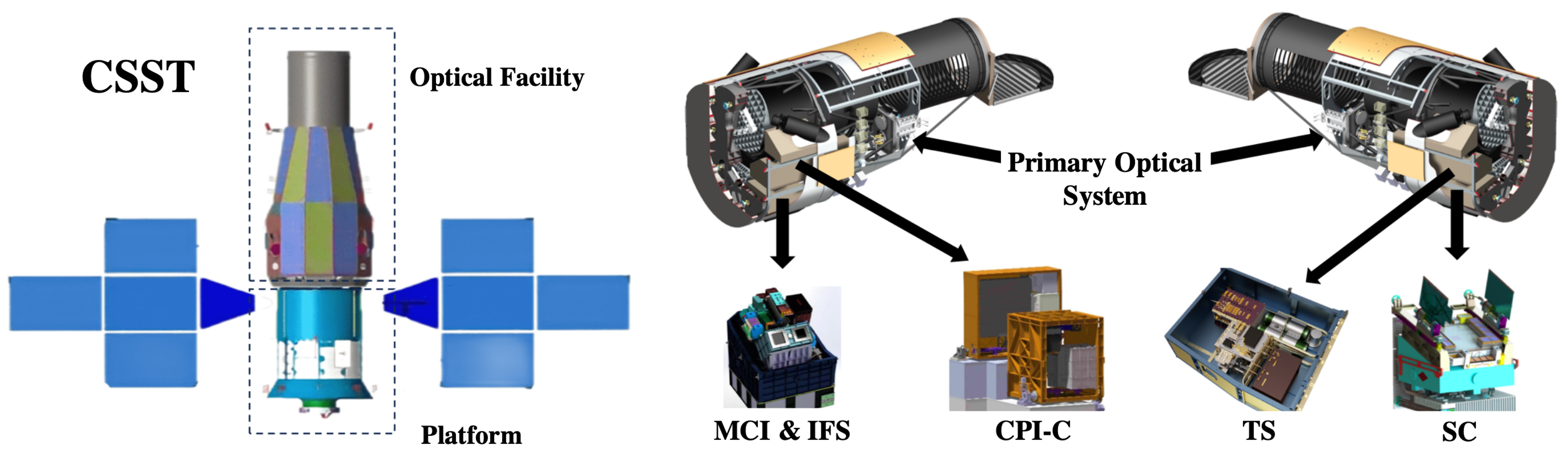
1 CSST platform
The CSST platform and survey optical facility adopt an integrated design and development methodology for the CSST scientific objectives. It can provide high-precision and high-stability pointing for both staring and tracking/scanning modes, rapid attitude maneuvering and switching of astronomical targets, electrical power management, and space ground communication support. The survey platform is responsible for the attitude control, autonomous orbit main tenance, active rendezvous, and docking during the 10-year mission. It is the first long-life low Earth orbit (LEO) platform that takes the CSS as the spaceport and can accept onorbit services.
2 Primary optical system
The CSST primary optical system adopts the Cook-type off- axis TMA design. Its primary mirror has an aperture of 2 m and a focal length of 28 m with a full field of view (FoV) of 1.72 deg2 and a FoV of 1.1° × 1° in the primary imaging area. Within this area, the dynamic image quality can reach REE80 < 0.15″, where REE80 is the radius of the point spread function (PSF) of 80% energy concentration region. Around it, there are short-wave infrared areas, wavefront sensing areas, fine guidance sensor (FGS) areas, etc. As shown in the right panel of Figure 1, the primary optical system is equipped with six image plane interfaces, which are symmetrically distributed on both sides of the primary mirror and tertiary mirror, corresponding to the five scientific modules, including SC, MCI, IFS, CPI-C, and TS, as well as one reserved interface. The switching between the focal planes is achieved by the module switching and the steering of the focusing mechanism. The CSST ensures the stability of the optical axis orientation during the observation through precise image stabilization systems (e.g., FGS and fast steering mirrors), passive vibration isolation, and other means.
3 Five scientific instruments
◥ Integral Field Spectrograph(IFS)
